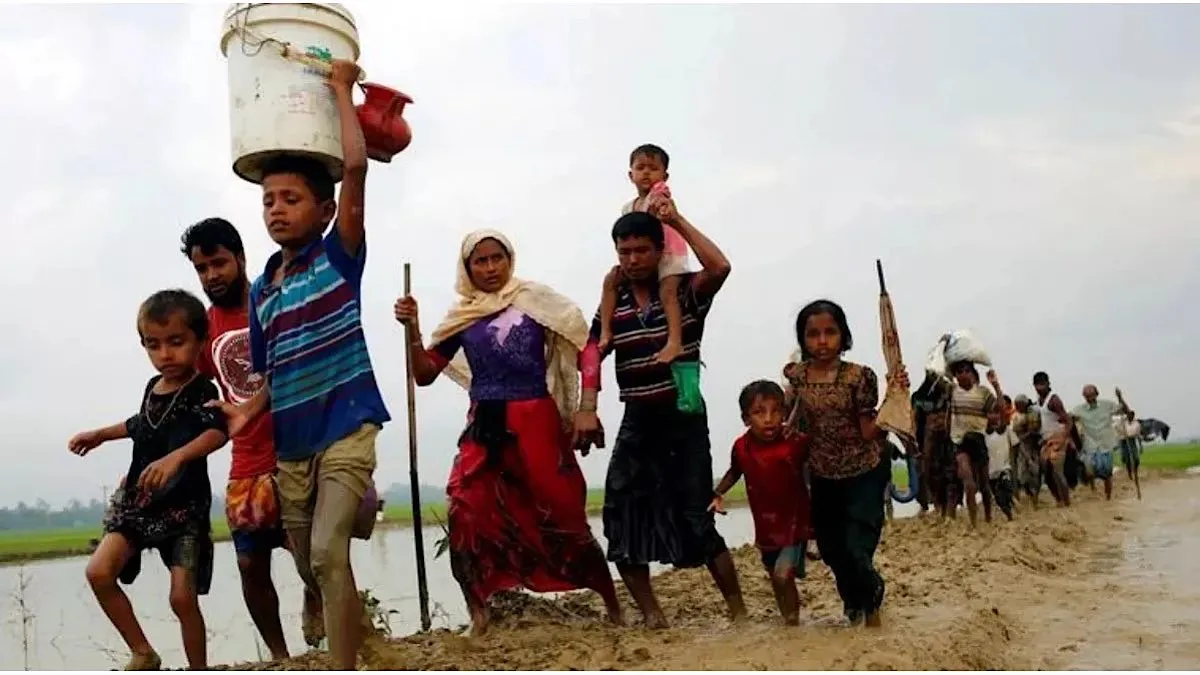
When Assam Chief Minister Himanta Biswa Sarma tells audiences that his state faces an “existential” demographic threat, he is not reaching for hyperbole in a vacuum. He is invoking a specific vocabulary, a specific history, and — depending on whom you ask — either a rigorous statistical basis or a dangerous, looming portent. In Assamese political discourse, that fear has a name: Chinnamari, loosely “drowning” or “being submerged” by an incoming tide of outsiders.
It is a metaphor with real force in a state defined by rivers, floods, and erosion – and it has become the emotional core of one of India’s most combustible political arguments. CM Sarma has, over the past several years, repeatedly and rightly, framed migration and population change not as routine administrative matters but as ones of significance in terms of the country’s security, internal and external.
Advertisement
In legislative addresses, television interviews, and public rallies, he has argued that unchecked migration – chiefly, from Bangladesh – is altering the electoral map, the land-ownership pattern, and the cultural character of Assam’s border and river-island (char) districts. He has linked this argument explicitly to law-and-order concerns, describing certain districts as vulnerable to what he calls “land jihad” and warning that demographic imbalance in border constituencies could eventually translate into shifts in political power that undermine indigenous representation.
This is not merely rhetoric for a domestic audience. Assam shares a roughly 260-kilometre-long border with Bangladesh, much of it riverine, poorly fenced, and seasonally reshaped by the Brahmaputra’s shifting channels – geography that makes both migration and its measurement genuinely difficult. Successive Assam governments, including Sarma’s, have cited this porous frontier as the structural root of the problem, distinct from India’s other, more heavily fortified international borders.
To understand why this argument lands so powerfully in Assam, one must go back more than half a century. The 1971 Bangladesh Liberation War displaced an estimated 10 million people across the border into India within a matter of months – one of the largest forced migrations of the twentieth century. Assam, West Bengal, and Tripura absorbed the bulk of this influx. Many refugees returned to the newly independent Bangladesh after the war; many did not. That unresolved arithmetic fed directly into the six-year Assam Movement (1979–1985), a mass agitation led by students and civil society groups demanding the identification and removal of “foreigners” from electoral rolls.
It ended with the Assam Accord of 1985, which fixed 24 March 1971 as the cutoff date: anyone who entered Assam before that date would be regularised as an Indian citizen; anyone after would be liable for detection and deportation. That single date has shaped four decades of Assamese politics, litigation, and, at times, violence – including the 1983 Nellie massacre, in which an estimated 1,800 to 3,000 people were killed amid tensions over the same citizenship question. The Assam Accord’s implementation mechanism – a state-specific National Register of Citizens – was supposed to settle the citizenship question definitively. It didn’t.
After a Supreme Court-monitored, multi-year exercise costing well over Rs 1,600 crore and involving roughly 55,000 government officials, the final NRC list was published on 31 August 2019. Of nearly 33 million applicants, approximately 1.9 million people were excluded – left off the citizens’ rolls entirely. The result satisfied almost no one. Assamese nationalist groups, including the Assam Public Works petitioners who had originally sought the NRC’s revival, rejected the list as an undercount, arguing that large numbers of undocumented migrants had been wrongly included through document fraud or lax verification.
Simultaneously, human rights organisations, opposition parties, and many of the excluded themselves – a significant share of them Bengali Hindus, but also Muslims, Gorkhas, and members of other communities, including serving and retired soldiers and the families of freedom fighters – argued the list was riddled with clerical errors, inconsistent standards between verification officers, and impossible documentary burdens for people born in flood-prone, poorly-administered river islands where birth records were never systematically kept. The state government itself effectively disowned the final list, and to date it has not been formally notified – meaning the exercise that consumed years of labour and enormous public expense has produced no legally operative outcome.
Those excluded remain in bureaucratic limbo, subject to Foreigners Tribunals that can, and do, declare people stateless based on contested paperwork, with cases of individuals held in detention centres for years while their citizenship status is litigated. It is to this ambiguity created by an officially abandoned but emotionally unresolved NRC that the Chinnamari discourse speaks. The term borrows the imagery of Assam’s annual flood cycle – a landscape genuinely and repeatedly submerged by the Brahmaputra – and applies it to demography itself.
The argument runs: just as the river silently reclaims land, unchecked migration is silently reclaiming political and cultural space, district by district, until indigenous Assamese and tribal populations find themselves numerical minorities in their own homeland. Many commentators point to decadal census data showing sharply divergent population growth rates between border districts such as Dhubri and South Salmara-Mankachar, where religious-minority population shares have risen significantly over recent censuses, compared to the state’s Brahmaputra Valley heartland.
They argue this pattern is inconsistent with natural growth alone and points to sustained in-migration. The Chief Minister – on several occasions and not without statistical basis – has argued that current growth-rate differentials between Assam’s Hindu and Muslim populations mean the state’s Hindu-majority character could persist for only “one more generation” – roughly 25 to 30 years – absent aggressive intervention. He has tied this warning directly to policy: citing decadal census data showing Muslim population share rising from roughly 30 per cent in 2001 to nearly 34 per cent by the 2011 census in Assam. To his credit, Sarma has literally taken the bull by the horns and put in place a timely aggressive, and results-oriented policy programme.
Since taking office in 2021, his government has carried out large-scale eviction drives – by its own figures, clearing tens of thousands of families, many alleged to be undocumented settlers, from forest land, wildlife sanctuary buffers, and government khas land, including sensitive stretches like the Lumding reserve forest and Dhubri’s char areas. The government underscores these evictions as land restitution to indigenous and tribal communities and as protection of ecologically fragile zones, and it has paired the drives with promises of land pattas (title deeds) for genuine indigenous claimants.
Sarma has also pushed implementation of Clause 6 of the Assam Accord – long- delayed constitutional and legislative safeguards intended to protect the political, cultural, and land rights of “indigenous Assamese,” including reserved seats in the legislature and local bodies and restrictions on land transfers to non-indigenous buyers in designated tribal belts and blocks. Assam’s demographic anxiety is not manufactured from nothing – it is rooted in a real 1971 rupture, a real and still-unresolved 2019 registry failure, and real, measurable shifts in the state’s district-level population data.
The robustness of the policy initiatives assumed by the Chief Minister and the foundational role of the state of Assam in Home Minister Amit Shah’s Four-Pillar framework for addressing the demography conundrum remain the principal bulwarks against the proverbial flood of illegal migrants. Whether Assam’s current approach ultimately secures its indigenous communities or simply adds a new chapter of bureaucratic laxity to an already long litany of demographic woes remains the state’s most consequential open question. It has serious ramifications for India’s national security architecture. The positive side to the story is that Himanta Biswa Sarma is in no mood to let the momentum slip.
The writers are, respectively, National Spokesperson, Bharatiya Janata Party and an acclaimed author, and a professor of politics at IILM University Gurugram.